
In 1927 a blind street preacher from Georgia recorded a piece of music with no words, no conventional melody, and no chord changes to follow.
Just a pocketknife pressed against a guitar string in Open D. And a voice that couldn't find words for what it needed to say, so it hummed and moaned instead.
That piece was Dark Was The Night, Cold Was The Ground by Blind Willie Johnson. And in 1977, fifty years later, NASA chose it as one of 27 pieces of music to put on the Voyager Golden Record. Sent into space to represent the diversity of life on Earth.

Of everything human beings have ever made, this was considered that important.
Now, a lot of what Johnson does on that recording is actually done with his voice. The slide plays its part, but the voice is doing a huge amount of the work. Which is why I also love to reference the Ry Cooder version — Dark Is The Night — because Ry does it all with the slide.
What Johnson does with his voice, Cooder does with the glass. And suddenly you can really clearly hear what's going on with all that shaping and squeezing.
The Paris Texas connection is a good story too. Wim Wenders was in the editing suite with no music sorted. He just took a bit of Ry's earlier recording of Dark Is The Night and dropped it into a scene. As soon as Ry heard it alongside the footage he said — that's it, that's the direction for the whole soundtrack. He went away and wrote Paris Texas — the main piece on the soundtrack — as a direct homage to Dark Is The Night. That one fragment of Blind Willie Johnson's playing, filtered through Ry Cooder, shaped one of the most celebrated film scores ever made.
What's actually going on
Now here's what I find so interesting about this piece as a slide player. When you listen to it and try to work out what's happening, it's both simpler and more mysterious than it first appears.
There is a scale. There are landing points. The structure is there if you listen for it.
But the music doesn't happen at the landing points. It happens in the journey between them.
The slide shifts seamlessly between major and minor — sometimes bright, sometimes dark, sometimes neither and both at once. And in those transitions, in the movement between one settled note and the next, Johnson finds something that a fretted guitarist simply can't reach.
We talked last week about blue note squeeze zones — the spaces between major and minor that we as slide players can get into so much more easily than someone bending strings. This piece is essentially a masterclass in that. The destinations are clear. The journey between them is where all the music lives.
There's a reason for that, and it's worth knowing about. When African musicians came to America and brought their musical traditions with them, the tuning system they used — based on the natural harmonic series, which is essentially physics — didn't quite fit the Western equal temperament system.
There were notes they wanted to pitch that you couldn't find on a keyboard or on the frets of a guitar.
So those notes ended up in the cracks. In between. And when African musicians took on the gospel chord progressions, the hymn tunes, the one four five — two traditions came head to head. And you feel that push and pull every time you listen to music like this.
|
"The blues scale is a West African scale forced into compromise with the twelve tone system.Not a European invention. An African survival" — Gerhard Kubik, ethnomusicologist
|
And as slide players, we're the ones best placed to honour it — because we can go where the notes are, rather than where the frets tell us they should be.
Your challenge this week:
Pull up both versions. Johnson first, then Cooder. Don't analyse them. Just listen to what they make you feel.
Then pick up your slide in Open D and have a go at painting a picture in those zones we talked about last week. Third fret toward fourth on the top string. The slow squeeze. See how much or how little you put into it. Think of it like colour — you can lean into the dark or keep it a bit lighter. The world's your oyster with the slide.
The key thing is control. If you're tense and jerky you won't be able to shape into those zones the way you want. Relax into it.
Think about how your voice would do it. That's really what you're after — making the slide sing!
Here's one of the diagrams from this week's masterclass to give you a visual on where those zones sit:
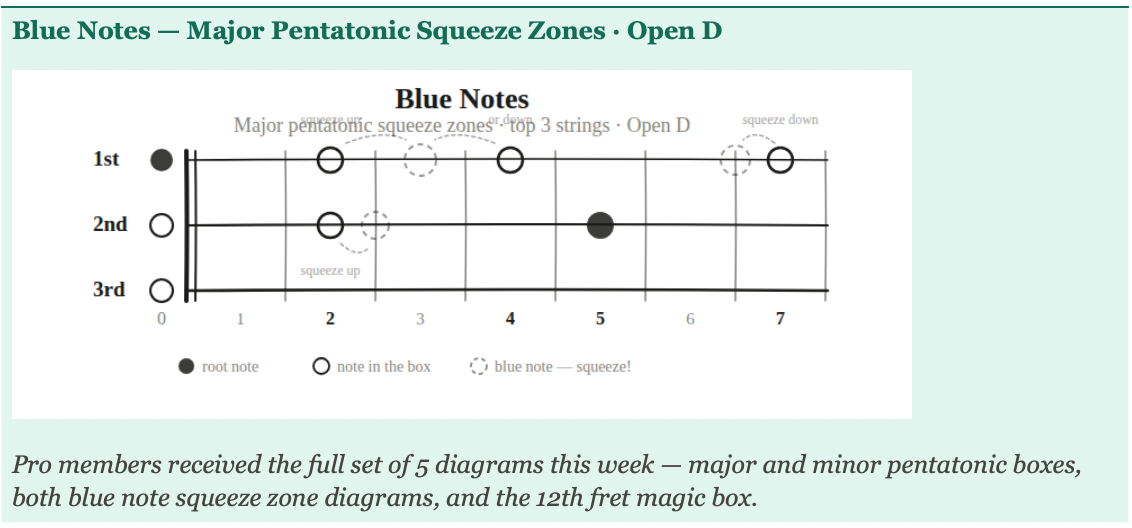
There's a whole world of sound in between those frets. Go and find some of it.
See you on the back porch.
You'll find my courses here and my free PDF Get Going With Slide here.