
I've got a bit of history for you today, a piece to play, and hopefully some serious inspiration for you and your slide.
It's 1903. A railway station in Tutwiler, Mississippi. A classically trained bandleader named W.C. Handy has fallen asleep on a hard wooden bench waiting for a train.
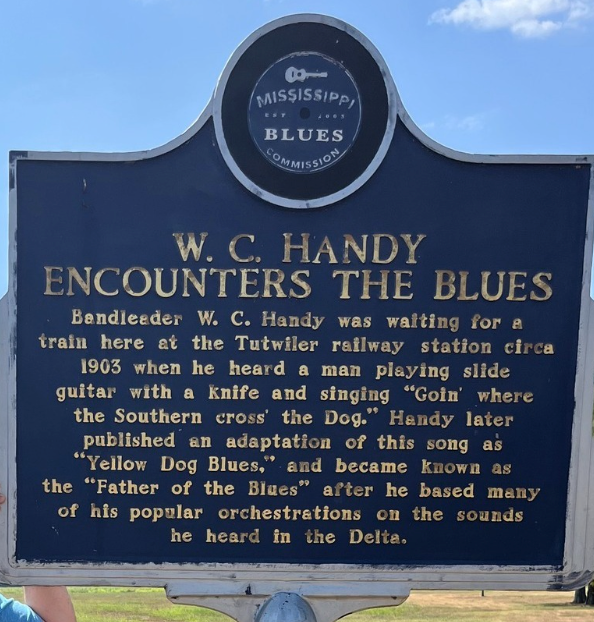
He wakes up to find a man sitting beside him. Ragged clothes. Shoes with holes in them. Playing a guitar with a knife pressed against the strings. Singing the same line over and over — “Goin' where the Southern cross' the Dog.”
Handy wrote about it later in his autobiography. He described the man like this:
"His face had on it some of the sadness of the ages. As he played, he pressed a knife on the strings of a guitar in a manner popularized by Hawaiian guitarists who used steel bars. The effect was unforgettable." — W.C. Handy, 1941
That moment — a classically trained musician waking up on a station bench in rural Mississippi — is the first documented written account of slide guitar. And what Handy heard that morning would go on to reshape all of American music.
Where it came from
Now here's the thing that I find fascinating about this. Handy compared the technique to Hawaiian guitarists — and he wasn't wrong. Hawaiian steel guitar was sweeping America at exactly the same moment. By 1916 it was outselling every other genre of recorded music in the country. Hawaiian guitarists were touring the South with vaudeville shows, playing on street corners.
So the slide technique was arriving from multiple directions at once. And next week I've got another piece of that story for you — from somewhere you probably wouldn't expect.
But the deeper root, the one that matters most to us as blues slide players, goes back much further than 1903. It goes back to West Africa.
The instrument that links it all together is called the diddley bow. A single wire nailed between two screws on a board. A glass bottle used as a bridge. Nothing else. You pluck the string and move a slide up and down to change the pitch. That's it.
The diddley bow derives from instruments in the Sahel region of West Africa - northern Nigeria and Mali - where they were often played by children, one beating the string with sticks and the other changing the pitch by moving a slide up and down. Enslaved Africans brought that tradition to America. In the rural South it became the starter instrument: cheap to build, requiring no formal training, and producing a wailing, moaning quality that could carry across fields and porches.
The kids who grew up playing diddley bows in Mississippi went on to become the blues legends. Bukka White. Big Joe Williams. Muddy Waters almost certainly played one as a child on Stovall's plantation before he ever touched a proper guitar.
The line from a wire nailed to a wall in West Africa to Blind Willie Johnson's pocketknife in Open D is a direct one. It just crosses an ocean and a few generations on the way.
The first recording
The first time slide guitar was captured on record was 1923, when a 26 year old Kentucky guitarist named Sylvester Weaver, using a knife, in New York City. Twenty years after Handy woke up on that bench. Those twenty years it was just passing from player to player across the Delta, out on the porches and the juke joints before anyone wrote it down or recorded it.
Why this matters to your playing
I think about all of this when I pick up the slide. Because what we're doing is part of something very old and very deep.
The technique of moving a hard object along a string to find the notes that live between the fixed pitches — that's not a guitar trick.
That's a musical impulse that survived a slave ship and a plantation and a hundred years of American history before it got anywhere near a recording studio.
The blue notes we've been talking about in these last couple of newsletters — the ones that live between the frets, the ones that slide players have such an advantage in finding — they were already on that diddley bow. Already in that music at Tutwiler in 1903. Already there in West Africa, long before it ever crossed an ocean.
When you squeeze your slide into that zone between the third and fourth fret on the top string and find that note, you're reaching for the same thing that man on the bench was reaching for when Handy woke up. That's worth knowing.
Have a go yourself: the one string exercise
Here is a simple piece to take into the Woodshed this weekend. And I mean really simple. One string only. Just like a diddley bow.
I've put together a little arrangement I'm calling Darkish Is The Night — Diddly Bow Version.
It's based on the Ry Cooder piece we talked about last week, stripped right back to the top string only in Open D.
No chords. No second string. Just you, your slide, and one wire — the same as those kids in Mississippi had on their wall.
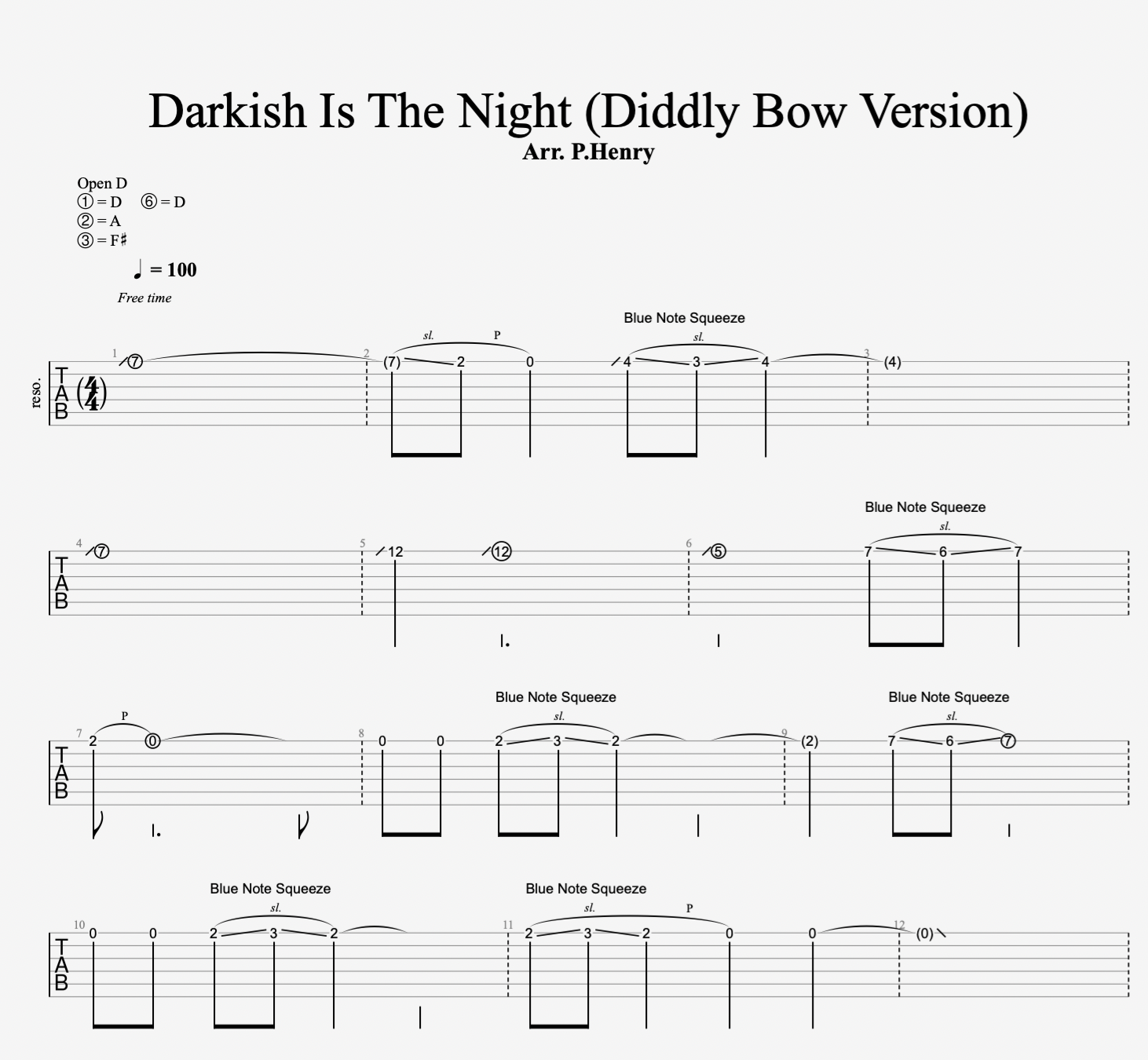
The main thing here is not the notes. It's the spaces between them. Let each note breathe before you move to the next one.
Slide into the notes rather than landing on them. And when you get to that blue note zone — the 2-3-2 movement in bars 8 to 11 — don't rush through it. That's where the music lives.
Try it slowly first. Then slower than that. Think about how your voice would sing it. Think about that man on the bench at Tutwiler and what he was reaching for with that knife on the strings. One string. That's all it takes!
Find your own version of what's in there.
If you want to go deeper on all of this - the blue note zones, the squeeze technique, the full tab analysis of the Ry Cooder arrangement - Slide Success Pro members got the full masterclass this month. Just drop me a line to find out more.
Check out my courses on my website, or pick up your FREE Get Going with Slide Guide here.
See you on the back porch!