
This week, in a live session, Paul Stevenson asked me a question I get a lot: why does an acoustic musician need a pedalboard at all? We play acoustic guitars, not electrics - so what's going on down there at my feet?
I plugged a few different instruments in and showed everyone exactly what's happening, so I thought it was worth writing up properly, because the answer tells you a fair bit about how live acoustic sound actually works.
THE DI SIGNAL DOESN'T SOUND LIKE YOUR GUITAR
The moment you plug an acoustic instrument straight into a PA, something's lost. It's loud, sure, but it's dry, aggressive, a bit abrasive - it doesn't sound like it's got much soul in it. That's the starting point for almost everything on my board.
Most of what I'm doing with pedals isn't chasing some huge transformation, it's making marginal gains. Softening the top end, warming the bottom, taking the edge off. You're not trying to change the world every time you hit a footswitch. You're just making the tone a bit more palatable - to your ears, and hopefully the audience's.
THE MOST IMPORTANT PIECE OF GEAR ON MY BOARD ISN'T ON THE BOARD
Before I even get to the pedals, there's a battered old preamp clipped to my mic stand, made by Orchid Electronics, who I don't think even make them any more. It gives me direct volume control and a simple three-band EQ tuned specifically for acoustic instruments, plus a mute switch for when I'm swapping guitars mid-song (which, let's be honest, is most songs).
If the power to my pedalboard ever dies - and it has, more than once - I can run straight into this and do a whole gig on it alone. Everything the pedals do, this does in real time, with my hand, guitar to guitar.
It's also how I stay involved in mixing my own sound. Even a great sound engineer doesn't know your instrument the way you do, so having that control right there on your mic stand means you're doing their job a favour, not fighting them for control of it.
SOME PEDALS FIX PROBLEMS, SOME ADD CHARACTER
Once the basic tone is sorted, the board starts doing a different job — adding interest. A touch of tremolo on a slower piece adds space. A freeze pedal turns a single note into a drone, so when I'm playing solo I get a sense of another player swelling in behind me — running the tremolo over that drone breaks it up so it doesn't sound like a phone dial tone.
A simple analogue echo adds depth without dropping you into a different room the way reverb does. It's a subtler trick, and on the lap steel it gives a bit of a '50s slapback feel.
None of this is essential. It's colour. But this is where the pedal collection starts to grow — and fair warning, it's highly addictive.
DIFFERENT PICKUP, DIFFERENT PROBLEM
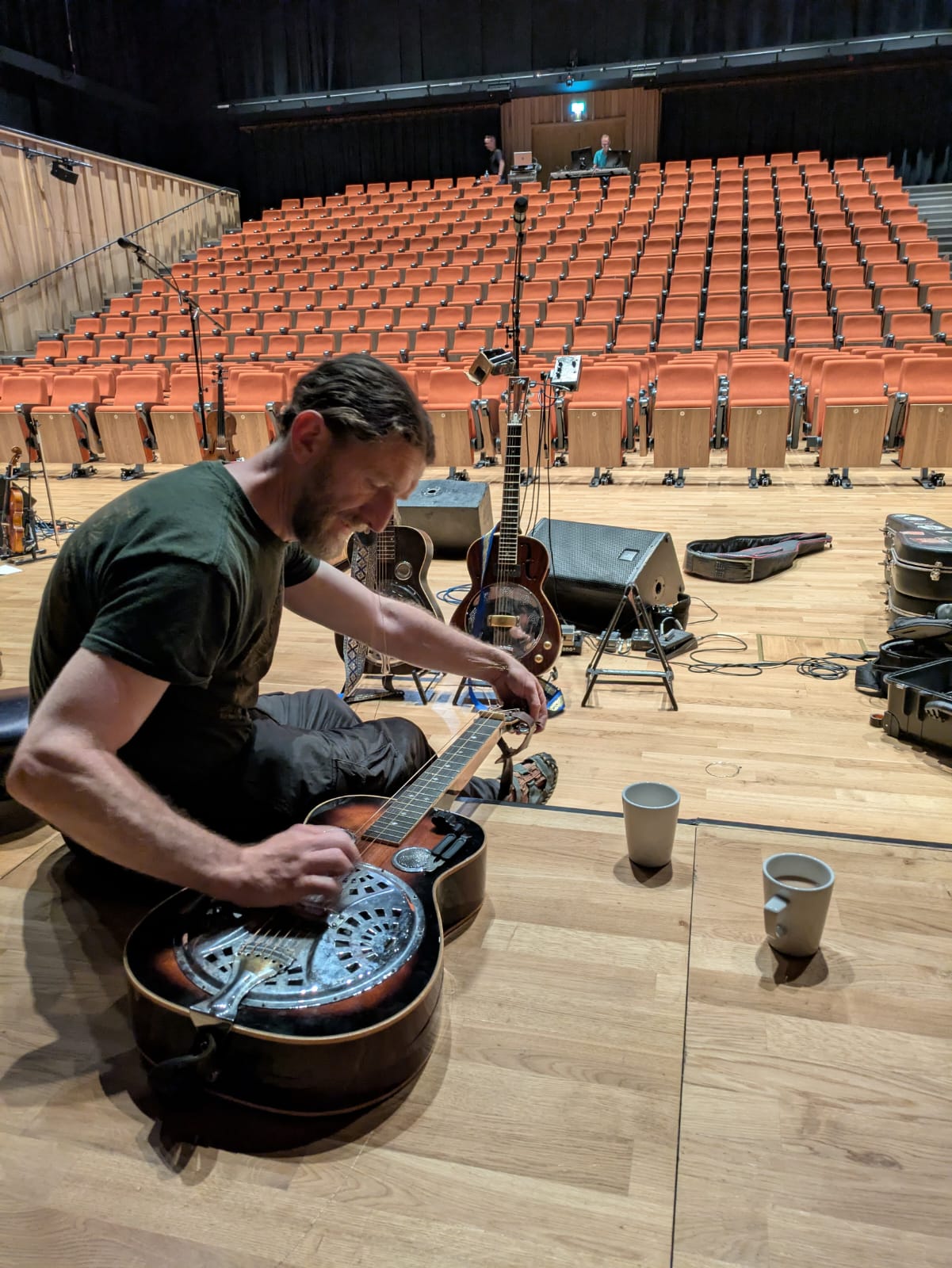
I also switched over to my electric lap steel, Little Jeffrey, and the DI tone on that P90 pickup was even rougher than the acoustic — it needed a proper amp simulator (a Boss IR-2) just to come alive, plus a volume pedal for the swells that are such a big part of that pedal-steel sound.
And on a resonator with a Fishman Nashville pickup, I use a Fishman Aura, which applies a modelled "microphone image" to the DI signal — recreating what a real mic on a real Dobro cone actually sounds like. Different pickup, same underlying job: make the direct signal sound like the instrument, not like a wire.
THE POINT OF ALL OF IT
A real microphone will always beat a DI signal for capturing what an instrument actually is. That's true every time, and it's why I always record through one. But live, a microphone gives you the sound of the instrument and nothing else.
Pedals let you shape a DI signal, add some character, and - usefully - dial in a bit more low end than a mic alone will give you, which matters when the audience has just had a fat, modern PA sound in their ears between sets and you don't want to sound thin by comparison.
That's really the whole answer to Paul's question: it's not that acoustic players need to sound electric. It's that the raw acoustic signal on its own needs a hand - and every pedal on my board is there to lend one.
If you're still working on getting your own tone sorted from scratch, Backporch Blues Riffs is still the best place to start — five riffs in Open D, built to get you making a genuinely good sound on your own guitar within the week. Click here to find out more.
See you on the back porch!