
Something a little different this week. If you've had BBC iPlayer on recently you may have come across a documentary called Operation Grand Canyon with Dan Snow. If you have — that's my slide guitar and harmonica you can hear on the soundtrack.
I thought it was worth telling you the story of how that came about. And the story behind the programme itself — because it's a remarkable one.
John Wesley Powell and the last unknown
In the spring of 1869 a 35-year-old one-armed Civil War veteran and self-taught scientist set off down the Colorado River into what was then the last uncharted territory in the United States. His name was John Wesley Powell. Nobody knew what lay inside the Grand Canyon. Nobody had ever come out the other side to describe it.
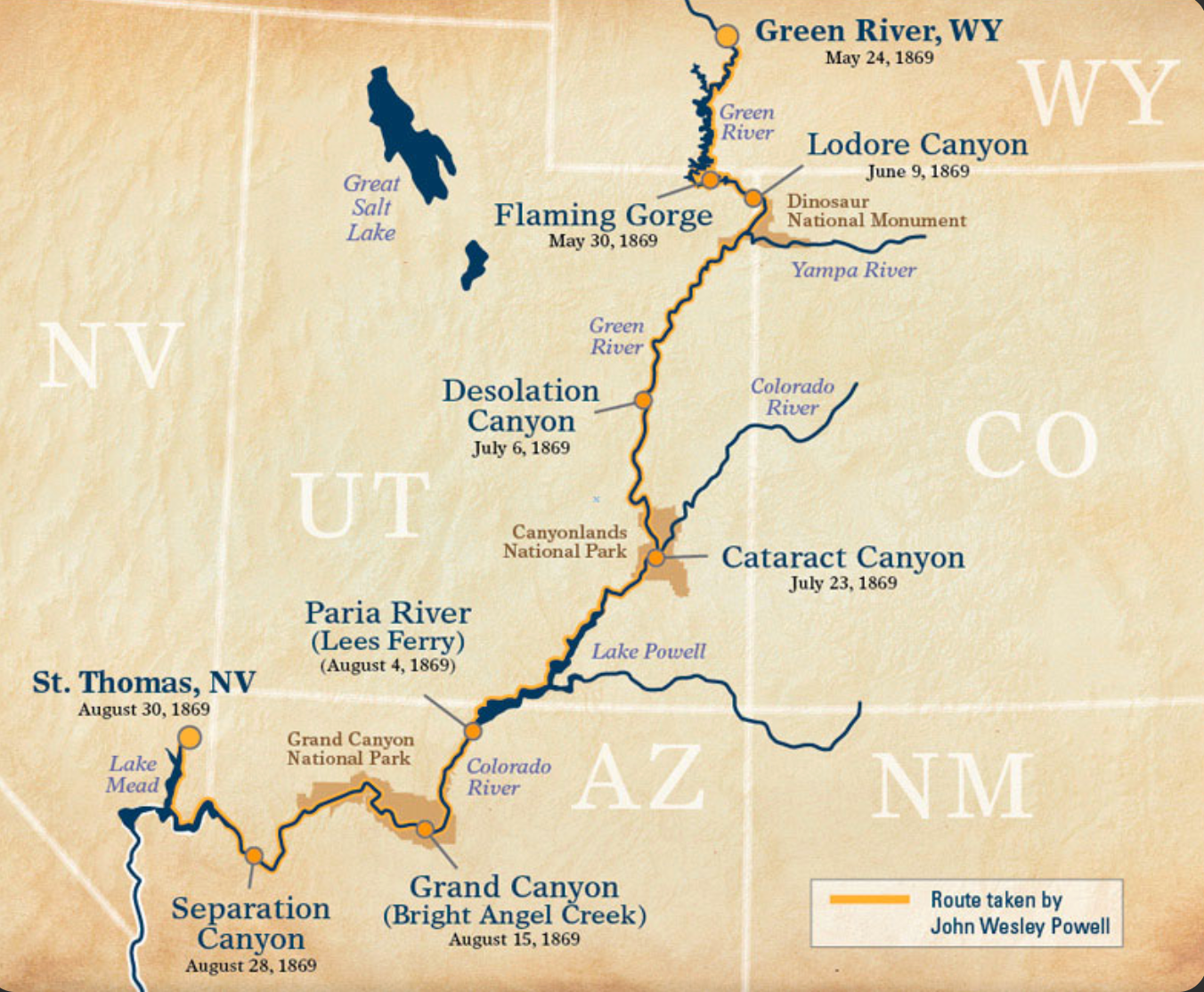
Powell and his crew of nine men took four wooden boats into the canyon. What followed was 99 days of one of the most extraordinary journeys in American history.
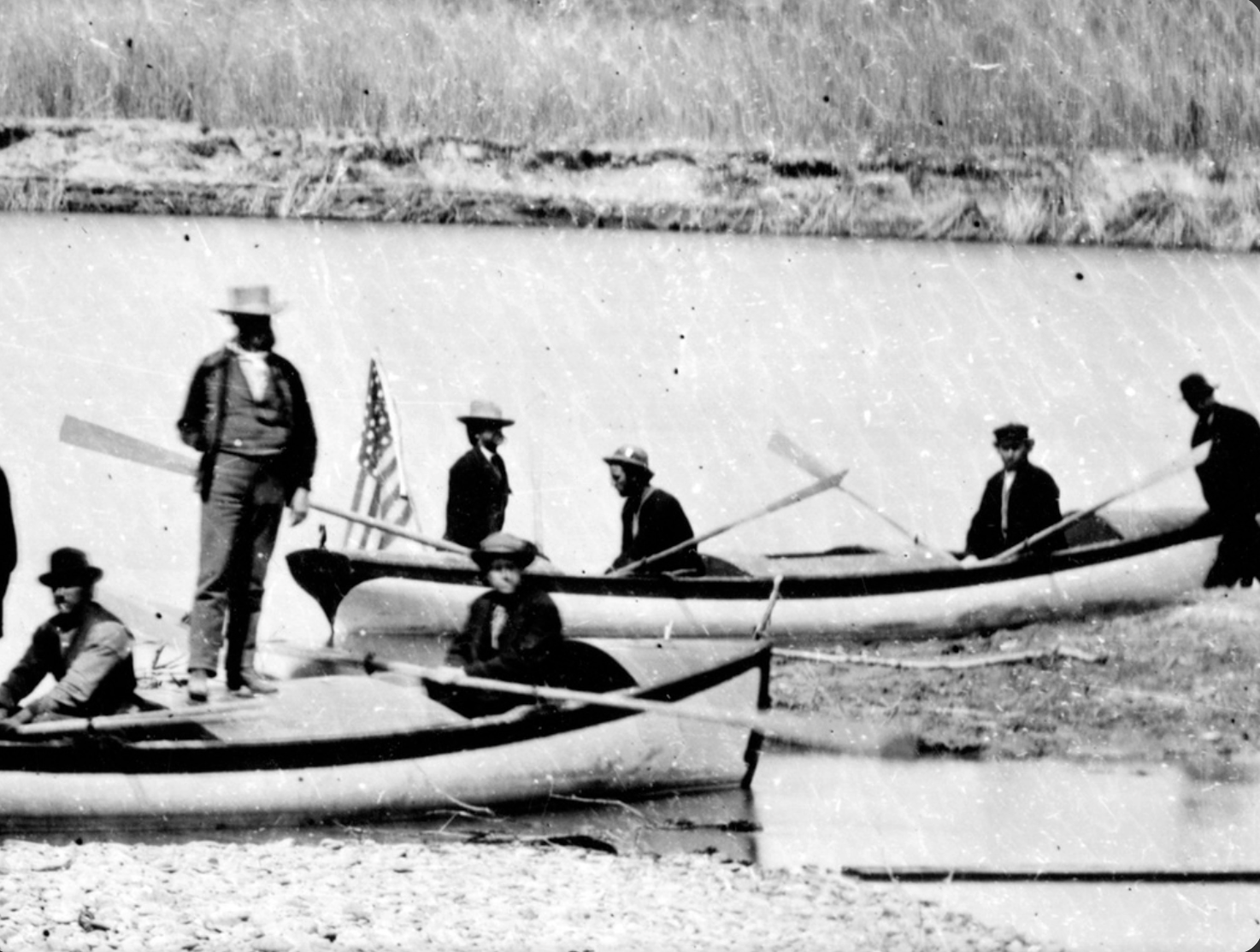
By mid-August they were more than a mile deep in the earth, the canyon walls closing in above them, brutally hot and close to starvation. Powell himself was thrown out of his boat running a rapid and had to swim to shore with one arm. Three of his men abandoned the expedition near the end and were never seen again.
Two days after those men turned back, Powell and the remaining crew emerged from the canyon. They had done it.
Powell later wrote about entering the unknown section: “We have an unknown distance yet to run. What falls there are, we know not; what rocks beset the channel, we know not. With some eagerness and some misgivings, we enter the canyon below.”
That sense of stepping into the unknown — with some eagerness and some misgivings — is as good a description of a creative challenge as I've ever read.
Dan Snow and the recreation
Operation Grand Canyon with Dan Snow — first broadcast on BBC Two in 2014 and back on iPlayer now — follows historian Dan Snow as he attempts to recreate Powell's journey.
The same 280-mile route down the Colorado River. The same antique-style wooden boats. A team of historians, geologists and scientists, taking on the same rapids that nearly finished Powell's expedition 150 years earlier.
It's part history documentary, part adventure. The white water sections are genuinely dramatic. The landscape shots — the Grand Canyon being what it is — have a scale and a stillness that's hard to put into words.
The programme has been shown around the world — it was a BBC and Discovery Channel co-production, so if you're not in the UK you may have come across it on Discovery, or on PBS in the States. If you haven't seen it, have a look for it wherever you watch.
I was asked to write the music for it. I worked with one of the programme's historians, Sam Willis, on some of the music — a collaboration that helped shape how the score sat alongside the historical content.
What I reached for
There's a tradition of the slide guitar as a scoring instrument that goes back to Ry Cooder's work on the Paris Texas soundtrack in 1984 — which we talked about earlier in this newsletter series. That score established the slide guitar as something cinema could use to evoke vast landscape, solitude, the American interior. Since then you hear it everywhere in film and television — any time a director wants that quality of space and longing, that sound of someone searching for something just out of reach. It's become part of the language of the moving image.
When I was asked to write the music for Operation Grand Canyon it felt like stepping into that tradition. A vast American landscape, a journey into the unknown, the slide guitar and harmonica as the natural voices for it.
Throughout the score you hear what we've been talking about in these newsletters — the power of both instruments to sing out just a few notes and carry an enormous amount of emotional weight.
The slide and the harmonica share something important: they can both wail and they can both groove.
A long crying note held over a wide canyon vista, vibrato doing the work, the note breathing with the image rather than competing with it.
Or short punchy riffs, attack and release, the rhythmic percussive quality both instruments have when you push them that way.
When you're writing music for a landscape that has been six million years in the making you very quickly learn that less is more.
For the faster sections — the white water, the rapids, the physical effort of navigating a wooden boat through fast current — both instruments shift into something more rhythmic. Short riffs, momentum, the music feeling like the effort and unpredictability of fast water.
The long crying note for the vast and still. The riff for the fast and physical.
If you want to hear what I mean, go to 47 minutes 49 seconds into episode one.
At that point two rivers converge. The water changes — darker, more violent, the current pulling in two directions at once. The mood of the whole journey shifts. What had been open and exploratory becomes something bleaker, more uncertain. Powell's crew would have felt it immediately.
The slide follows that shift. It moves into the minor pentatonic, reaching for the blue notes — those notes between the frets that sit in the gap between major and minor, between hope and something harder.
It's the same territory Blind Willie Johnson was working in when he recorded Dark Was The Night in 1927. The same quality Ry Cooder found when he scored Paris Texas. A sound that doesn't explain the emotion — it is the emotion.
That moment at 47:49 is the heaviest Blind Willie Johnson influence in the whole score. I wasn't consciously thinking about him when I recorded it. But those players live in your fingers after enough years. When the image asked for something darker, that's where the slide went.
Keep Your Lamps Trimmed and Burning
The piece that ended up over the closing credits was Keep Your Lamps Trimmed and Burning — a traditional spiritual that I've arranged as a beatbox harmonica piece. Just me, one harmonica, playing percussion and melody simultaneously.
I've been playing this piece for years. It grew out of a long obsession with what a single instrument can do when you push it past its obvious limitations. The harmonica wasn't designed to play rhythm and melody at the same time. Doing it anyway — finding the way in — is exactly the kind of problem I find most interesting.
Hearing it over the end of a BBC documentary felt like a full circle moment. A piece developed over years in practice rooms and on stage, suddenly sitting at the end of something watched by a lot of people who'd never heard of me. Check it out on spotify here:
https://open.spotify.com/track/2f0nMCaxg76NgurkiyuBuE?si=510da991c5ab4585
What scoring for picture teaches you
The thing about writing music for film or television is that the image is always the boss. You can't fall in love with your own ideas. You can't hold onto a phrase because you like it if it doesn't serve the shot. Every note has to earn its place.
That discipline maps directly onto what I try to teach in slide guitar lessons. Don't play what you know. Play what the moment needs. Listen to what's happening and find the note that serves it.
The Grand Canyon is a humbling subject. Powell's journal, his crew's accounts, the sheer scale of what they did in those 99 days — you come to it with your slide guitar and your harmonica and you try to find something worthy of it without overstating your own contribution.
That's a good way to approach any piece of music.
This week in the woodshed
Go and watch Operation Grand Canyon with Dan Snow on BBC iPlayer — you can find it here. If you're outside the UK, search for it on Discovery or PBS — it's been shown around the world.
Skip to 47 minutes 49 seconds into episode one. Listen to what the slide does when the two rivers meet. Then go back and watch the whole thing from the beginning.
Then watch it again with the sound off. Pick up the slide and play something over the top. The landscape shots, the white water, the moments of stillness. Don't think too hard about it. Just find the note that the image seems to need and let it breathe.
You'll learn more about space, economy and listening in twenty minutes of that exercise than in hours of conventional practice. The image is an unforgiving teacher. It tells you immediately when you're playing too much.
If you'd like to explore this kind of expressive, intentional slide playing in a structured way, I'll be opening a limited number of places on the 30-Day Slide Launchpad again in late September. Drop me a WhatsApp if you'd like to be first to hear about it.
See you on the back porch!