
Last week I blogged about Fred McDowell and You Gotta Move, and how the slide and the voice become almost indistinguishable.
This week I want to go one step further back. Before the guitar. Before the slide. To where the blue notes live in their most natural, unmediated form.
The human voice.
What Alan Lomax found
Alan Lomax spent decades doing something that no one else was doing — travelling across America with a recording machine, pointing it at people who would otherwise never have been heard, and capturing music that would otherwise have been lost forever.
He recorded Fred McDowell emerging from the woods in Como, Mississippi. He recorded chain gang prisoners at Parchman Farm. He recorded Georgia Sea Island Singers keeping alive traditions that stretched back to West Africa. He understood that the most important music in America was not in the concert halls or the recording studios — it was on the porches and in the fields and in the prison camps, being made by people who had no idea they were making history.
The work song tradition he captured is where so much of the blues phrasing comes from. Not from guitarists learning from other guitarists. From voices. From the rhythmic pulse of physical labour. From men and women finding the blue notes under conditions of extreme hardship — not because they knew music theory, but because those notes were the truest expression of what they needed to say.
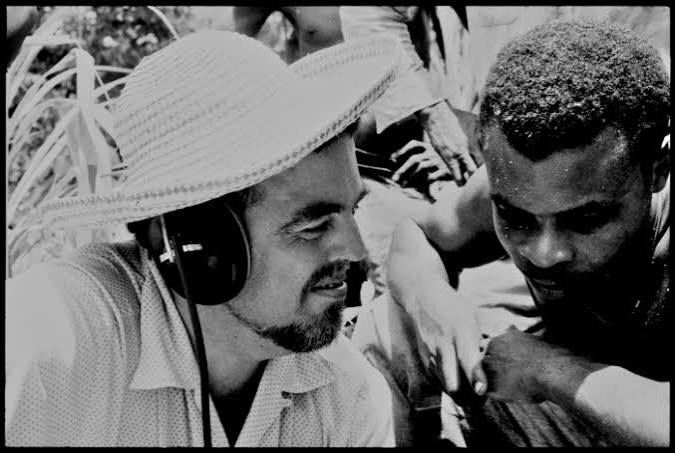
The blue notes we've been talking about for months — the squeeze between frets 3 and 4, the notes that live between major and minor — they didn't start on a guitar. They started in a human throat, reaching for something that twelve-tone Western tuning couldn't contain.
Bessie Jones and the Georgia Sea Island Singers
Bessie Jones was one of the great carriers of this tradition. Born in Georgia in 1902, she grew up with the songs of the Sea Islands — a group of barrier islands off the coast of Georgia and South Carolina where African cultural traditions had survived in a remarkably intact form, partly because of the relative isolation of the communities there.
The Georgia Sea Island Singers kept alive ring shouts, work songs, game songs and spirituals that connected directly to West African musical traditions. Lomax recorded them extensively and they became central figures in the folk revival of the 1960s.
Bessie Jones's voice is extraordinary. The blue notes she finds — the microtonal inflections, the notes that sit between the Western scale positions — are instinctive and precise at the same time. She's not thinking about music theory. She's singing what she feels. And what she feels sits exactly in those zones that we've been trying to reach with the slide.
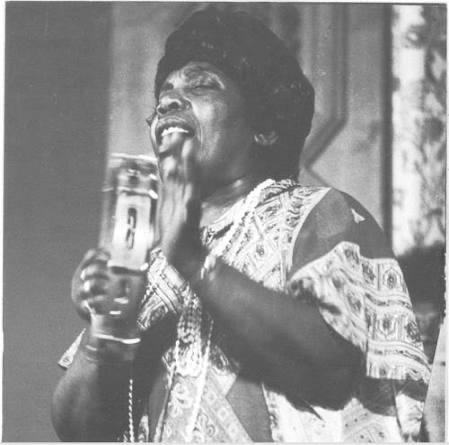
Sink Em Low
Have a listen to Sink Em Low by Bessie Jones and the Georgia Sea Island Singers, from the Alan Lomax recordings, on the album Join the Band. You can find it on Spotify here:
https://open.spotify.com/track/1bZwtgX7d38xyKtdu3jUPB
It's a chain gang work song. The kind of song that was sung to coordinate the rhythm of physical labour — the swing of an axe, the driving of a stake. The pulse of the music is the pulse of the work. And within that pulse, within that hypnotic repetition, Bessie Jones finds blue notes and vocal inflections of extraordinary expressiveness.
Listen to the phrasing. The way each phrase starts, rises, bends, resolves. The call and response between the lead voice and the group. The space between the phrases — the silence that carries as much weight as the notes.
This is the source. This is what the blues is made of.
Taking it to the slide
I've arranged Sink Em Low for slide guitar. And what makes it such a useful piece to work with is that the process of arranging it is itself the lesson.
You listen to the vocal phrase. You try to sing it. Then you try to find it on the slide. The blue notes Bessie Jones sings naturally — the inflections that make the phrase feel the way it feels — those are exactly the notes in the squeeze zones we've been working on. The slide finds them the same way her voice does. Not by hitting a fixed pitch, but by moving through a zone, finding the note in motion.
I teach this piece as part of the 30-Day Slide Launchpad. It works particularly well on the top string — the vocal melody sits naturally there in Open D — but it also translates beautifully down to strings 4 and 5, where it takes on a deeper, earthier quality that's even closer to the original chain gang feel.
The slide and the voice
We've been building toward this point across the last few newsletters. The singing before you play idea from Calcutta. The harmonica players finding the blue notes by bending. McDowell's slide and voice becoming interchangeable. Now this — the voice as the original instrument, finding the blue notes before anyone had a guitar to play them on.
But here's the thing I keep coming back to. It's not just that the slide can follow the voice. Working with a piece like Sink Em Low, I've found that the process goes the other way too.
When you spend time finding Bessie Jones's vocal phrases on the slide - really hunting for those inflections, those blue note squeeze zones, those moments of tension and release - your ear gets trained. You start to hear the notes between the notes. And once you can hear them, your voice starts to reach for them too.
The slide teaches the ear. The ear teaches the voice. The voice teaches the slide. It's a circle, and Sink Em Low is one of the best ways into it I've ever found.
Before the guitar there was the voice. And the voice is still the destination.
This week, let's focus on one track, and just one exercise.
Bessie Jones, Sink Em Low (Georgia Sea Island Singers, Alan Lomax — Join the Band, 2012)
Find it on Spotify using the link above. Listen to the whole thing first without your guitar. Then listen again and try to sing along - find the blue note inflections with your own voice before you pick up the slide. Then take it to the top string in Open D and see how close you can get.
Don't worry about being precise. This isn't about note perfect reproduction. It's about chasing the feeling.
Sink Em Low is one of the pieces I teach in the 30-Day Slide Launchpad - along with You Gotta Move and a handful of other pieces chosen specifically because they connect your slide playing directly to the vocal tradition. I'll be opening a limited number of places in late September. Spaces will be limited so if you'd like to be first to hear about it drop me a WhatsApp.
See you on the back porch!