
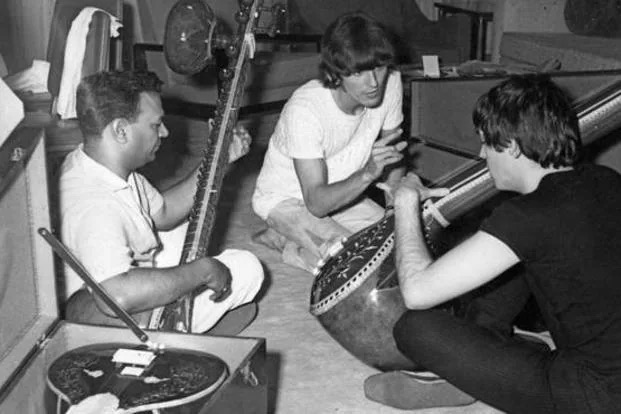
My fascination with Indian music started the same way it did for a lot of people of my generation: George Harrison. The Beatles. That extraordinary moment in the mid-60s when the sitar started appearing on pop records and suddenly the whole world got a little bit bigger.
That spark stayed with me for years. And eventually, in my search for all things slide guitar around the world, it took me to Calcutta, where I studied Indian classical slide guitar with one of the most remarkable musicians alive. Pandit Debashish Bhattacharya, the Grammy nominated BBC award winner who is one of the world's great slide guitarists - and the inheritor of a tradition that goes right back to the man who pioneered raga on the slide guitar, Pandit Brij Bhushan Kabra, in the 1960s.
The man who may have started it all
In the 1870s, according to some accounts, a young man born in India was kidnapped by a Portuguese sea captain and taken to Honolulu. His name was Gabriel Davion.
In 1884 a Hawaiian composer named Charles E. King saw Davion playing guitar in what he described as a "new way" - with a slide. And some historians believe that what Davion was doing was carrying a technique from India that had existed for centuries, from an ancient instrument called the Vichitra Veena.
The Vichitra Veena is a fretless string instrument played with a smooth glass ball pressed against the strings, sliding and swooping along them to find the notes. Not the fixed notes. The notes between the notes. The slides and glides and microtonal inflections that live in the spaces Western tuning can't accommodate.
The slide technique, in other words, may have existed in India for over a thousand years before it arrived in Hawaii, before it crossed to Mississippi, before a ragged man pressed a knife against his guitar strings at Tutwiler station and Handy woke up on that bench.
Nobody knows for certain. The story is contested. But given what I've seen and heard in Calcutta, it doesn't surprise me in the least.
The Indian word for blue note
We've been talking these last few newsletters about blue notes. The squeeze between the third and fourth fret. The note that lives between major and minor. What makes the blues sound like the blues.
When I started studying in Calcutta I had one of those moments where something you already know suddenly gets a lot bigger.
Because in Indian classical music they've been talking about exactly the same thing for over a thousand years. They just have a different name for it.
They call them shrutis. The word comes from the Sanskrit for "that which is heard." Where Western music carves an octave into twelve fixed notes, Indian classical music recognises twenty two — the subtle microtonal positions that live in the spaces between. The notes between the notes.
It's the same note, the same impulse. The same search for the human, vocal, expressive quality that lives between the fixed pitches. The blues got there through West Africa and the Mississippi Delta. Indian classical music got there through thousands of years of raga tradition and the ancient Vichitra Veena.
The slide guitar is the instrument that finds them both. And that's why when Pandit Debashish Bhattacharya picks up a slide in Calcutta and when Blind Willie Johnson pressed a pocketknife against his strings in Open D, they are reaching for exactly the same thing.
The lineage — and the full circle
What I find extraordinary, and what I think about every time I pick up the slide, is that there is a direct line from Pandit Brij Bhushan Kabra, the man who first played ragas on the slide guitar in the 1960s, through Pandit Debashish Bhattacharya in Calcutta, to a guitar teacher in a small studio in Wales.
That line carries something. A way of thinking about the slide that is older than the blues, older than Hawaii, older than any of the American story we've been talking about these last few weeks.
And here's where it all comes full circle. In 1993 Ry Cooder walked into a studio with Indian slide guitarist Vishwa Mohan Bhatt and recorded A Meeting by the River. Two traditions — the Mississippi Delta and the Indian classical — sitting in the same room, playing the same instrument, reaching for the same notes. It won the Grammy for Best World Music Album.
Put it on and you'll hear everything we've been talking about in these last few blogs in one extraordinary recording.
When you squeeze your slide into that zone between the third and fourth fret on the top string and find that note — you're not just playing the blues. You're reaching for something that musicians on the other side of the world have been reaching for since before the guitar existed.
Have a listen
Three recordings. Three strands of the same story.
Call of the Valley — Brij Bhushan Kabra with Hariprasad Chaurasia and Shivkumar Sharma, 1967. The record that introduced raga to the slide guitar. Listen to what Kabra does with the slide — the glides, the inflections, the notes between the fixed pitches. You'll recognise every impulse even if the musical language is completely new to you.
3: Calcutta Slide Guitar — Debashish Bhattacharya. The man I studied with. One of the most extraordinary slide guitar recordings you will ever hear. Put it on and just listen.
A Meeting by the River — Ry Cooder and Vishwa Mohan Bhatt, 1993. The moment the two traditions sat in the same room. Grammy winning. Essential. Everything we've been talking about in one recording.
You don't need to understand the ragas to feel what's happening. The instrument is doing the same thing it always does — finding the notes between the notes and making them sing.
Find my classes and courses online here or pick up your FREE Get Going with Slide Guide here.
See you on the back porch!